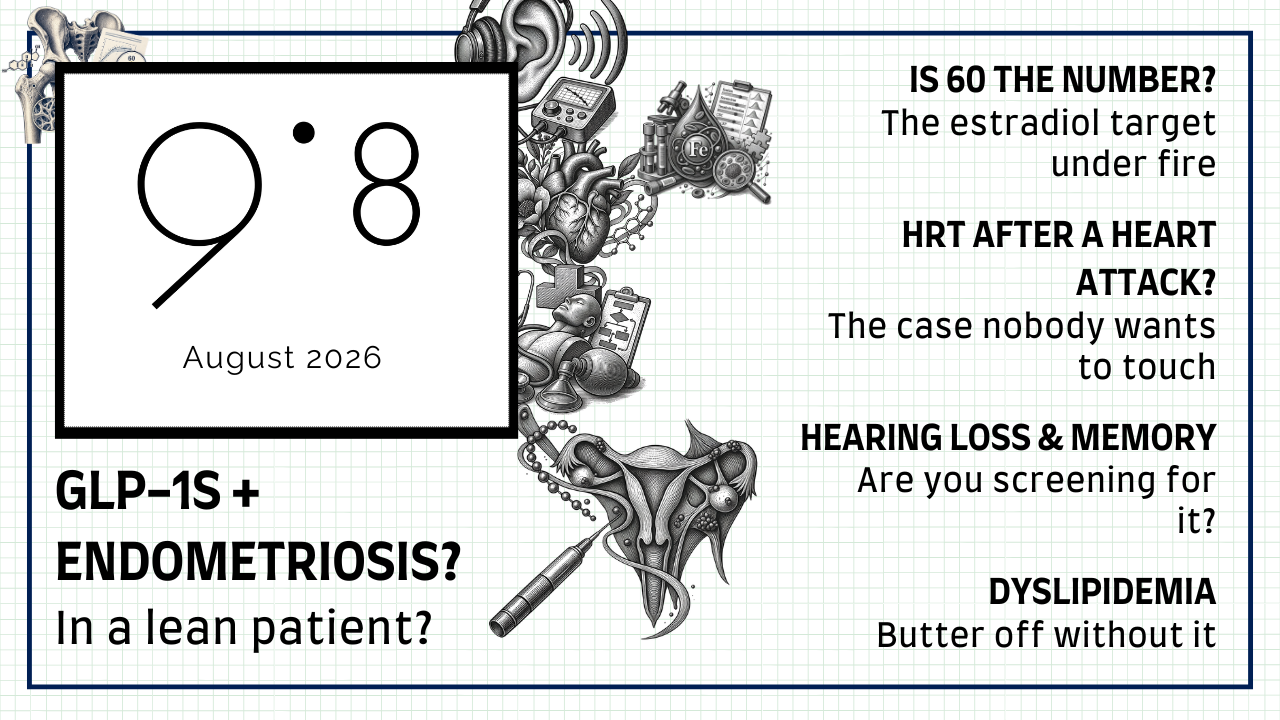


We spent an evening at a Lilly-sponsored lecture by Dr. Megha Poddar (obesity medicine specialist, professional myth-buster) and walked out with two GLP-1 pearls worth stealing.

Tip 1: GLP-1s and pregnancy. Plot twist incoming.
For years the party line has been: stop the GLP-1 at least a month before conception, because surely suppressing appetite in a growing human is a bad idea. Very tidy. Very intuitive. Very possibly wrong.
Enter the accidental cohort: thousands of women who conceived on therapy and stayed on it unknowingly through 6–8 weeks. And these pregnancies? Running with less gestational diabetes, less preeclampsia, and better outcomes for both mom and baby than expected. Meanwhile, the women who dutifully stopped preconceptually regained an average of ~8 lb in the run-up to pregnancy, and that pre-pregnancy pop is itself a card-carrying driver of gestational disease. The cure was worse than the cure.
The first real safety data are in. Dao et al. (BMJ Open, 2024) prospectively followed 168 first-trimester GLP-1 RA-exposed pregnancies across six Teratology Information Services and found no increased risk of major birth defects or pregnancy loss vs. diabetic and overweight/obese controls. And per MotherToBaby's plain-language summary (Muller, MSPH, CG, USF Maternal Fetal Medicine), the pooled experience across studies of >1,000 first-trimester exposures likewise shows no increased birth defect signal. Small numbers still, cautious interpretation still, but the signal is holding, and it's consistent with what obesity medicine is quietly seeing at scale.


The official line hasn't caught up yet: product labels still say stop at least 2 months before conception, and MotherToBaby explicitly does not recommend continuing GLP-1s once pregnancy is confirmed, partly because gestational weight loss can drive SGA, partly because we have essentially zero second- and third-trimester data. Fair.
But Dr. Poddar's prediction is this: within the next year, guidance will start shifting toward continuing GLP-1 therapy through conception and into early pregnancy in higher-risk metabolic phenotypes, where the 8-lb preconception rebound is doing more harm than the drug ever would. Not the recommendation yet. But the tectonic plates are moving.

Tip 2: The "GLP-1 holiday" is a trap. Please stop selling it.
Every patient loves the fantasy: a cruise, a summer off, a "reset." What we are absolutely failing to warn them about is what greets them on the return flight.
Two mechanisms. Both rude.
- Body composition drift. Weight lost on GLP-1s is roughly 75% fat / 25% lean mass. Weight regained during a pause is ~100% fat. So every hiatus rebalances your patient in the wrong direction. Less muscle → lower resting metabolic rate → baseline that is worse than pre-treatment. They come back metabolically demoted.
- Ghrelin rebound. Ghrelin, the hormone that drives hunger and whispers sweet nothings about visceral fat storage, doesn't just return to baseline after you stop. It comes back higher than it ever was. Which is why patients pause at 5 mg, restart, and suddenly need 7.5 mg to feel anything. That is not tolerance. That is a hormonal ambush.
Clinical takeaway: Stop calling it a "course." GLP-1 therapy is chronic disease management, same conceptual lane as antihypertensives and statins. If a pause is truly unavoidable (cost, supply, pregnancy planning under current guidelines), pair it with resistance training and unapologetic protein intake to defend the muscle, and warn your patient the restart dose is probably going to be higher. Managed expectations are cheaper than dignity.
Full deep dive coming in WeightRx.

FLOW: The moment semaglutide stopped being a metabolic drug and started being a nephrology drug.
What if we told you the GLP-1 kidney story is now sitting shoulder-to-shoulder with the SGLT2i kidney story, in the same weight class, throwing hands?
The receipts: FLOW (Perkovic et al., NEJM 2024)
3,533 patients with T2DM + CKD (eGFR 25–75, elevated ACR), semaglutide 1.0 mg SC weekly vs. placebo. Median follow-up 3.4 years.
- Primary composite (kidney failure, ≥50% eGFR decline, kidney or CV death): −24% (HR 0.76, 95% CI 0.66–0.88, p=0.0003)
- MACE: −18%
- All-cause mortality: −20%
- Annual eGFR decline: slowed by 1.16 mL/min/1.73m²
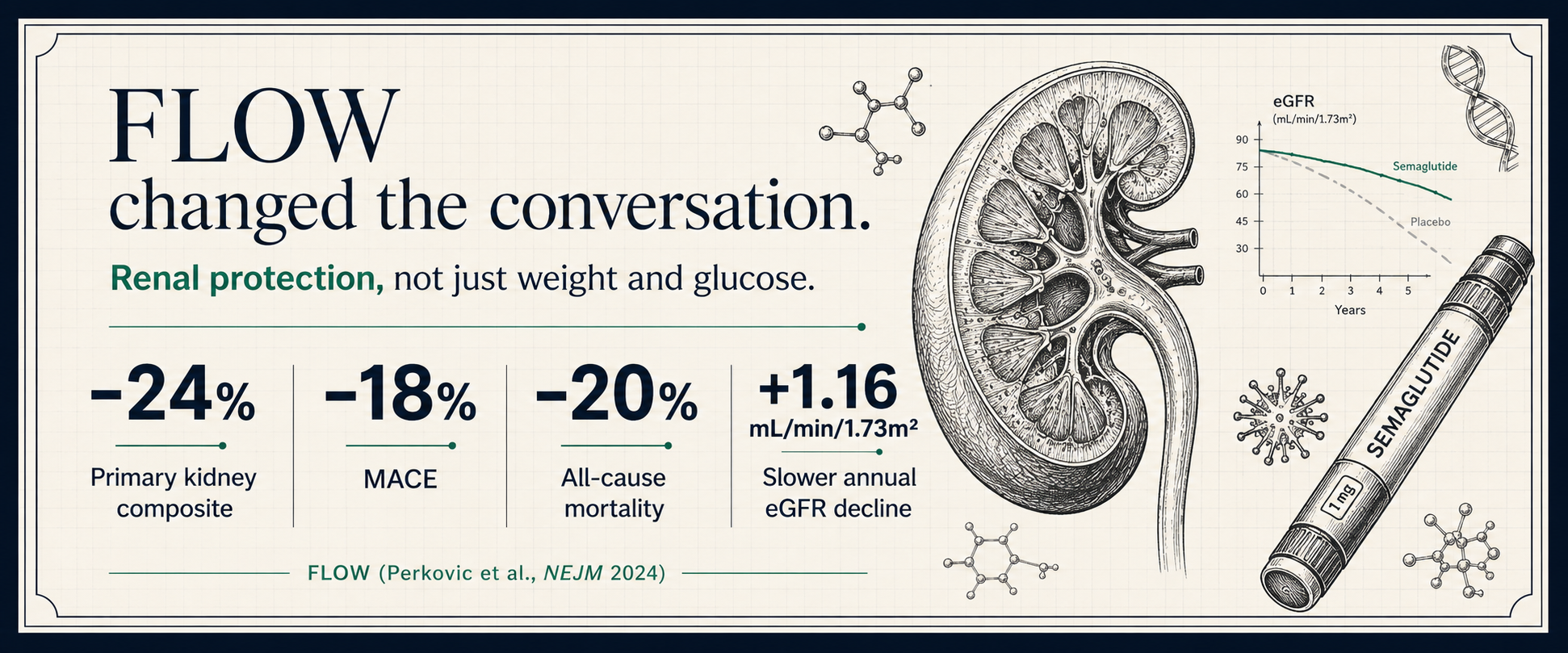
Read that mortality number one more time. Twenty percent. On a drug most doctors are still filing under "cosmetic."
Meanwhile in real life: Health Canada approved the CKD indication in August 2025. ADA 2025 has already promoted GLP-1 RAs with proven kidney benefit up the algorithm for albuminuric CKD on maxed-out ACEi/ARB, independent of A1c. Your patient's sugars can be gorgeous. The kidneys still get the drug.
Bottom line: If you're still pitching GLP-1s to your CKD patients as "weight and glucose," you are decades behind the poster. This is a renal-protection conversation now. The metabolic wins are the free appetizers.
Fully unpacked in WeightRx.



Trend Alert: The ferritin/CRP ratio is out here quietly saving careers.
You know the patient. Autoimmune, or obese, or chronically inflamed, or just carrying the ambient inflammatory load of being a human in 2026. Ferritin comes back at 90, maybe 120. Bloodwork says: nothing to see here. Your gestalt is screaming: this woman is iron deficient and you know it.
Your gestalt is right. Ferritin is an acute-phase reactant, which means inflammation cranks it up whether or not there's actual iron in the tank. So a "normal" ferritin in an inflamed patient is basically a fog machine.

Enter the ferritin/CRP ratio (Urbanski et al., QJM), the world's most quietly useful back-of-envelope calculation:
Ferritin (µg/L) ÷ CRP (mg/L) (with a CRP floor of 5 mg/L)
A ratio ≤ 6 suggests iron deficiency in inflammatory contexts, even when raw ferritin looks respectable. This is the math that catches the ferritin-of-90-but-actually-empty patient every single time.
We've baked this into our lab review workflow at Gravity, and treatment decisions are shifting weekly. If it's not in your template, add it tonight. Your foggy, tired, "my labs are always fine" women will send you thank-you notes as soon as their brains switch back on.

"Can I use Slynd and oral micronized progesterone together to get the best of both?"
Reader, yes. Yes you can. And in the right patient, you absolutely should.
The Director's Cut answer: These two molecules are not competing for the same job. They are, in fact, on entirely different payrolls. Putting them on the same team is not redundancy, it's a superduo. Think Beyoncé and Jay-Z. Different lanes, same power move.
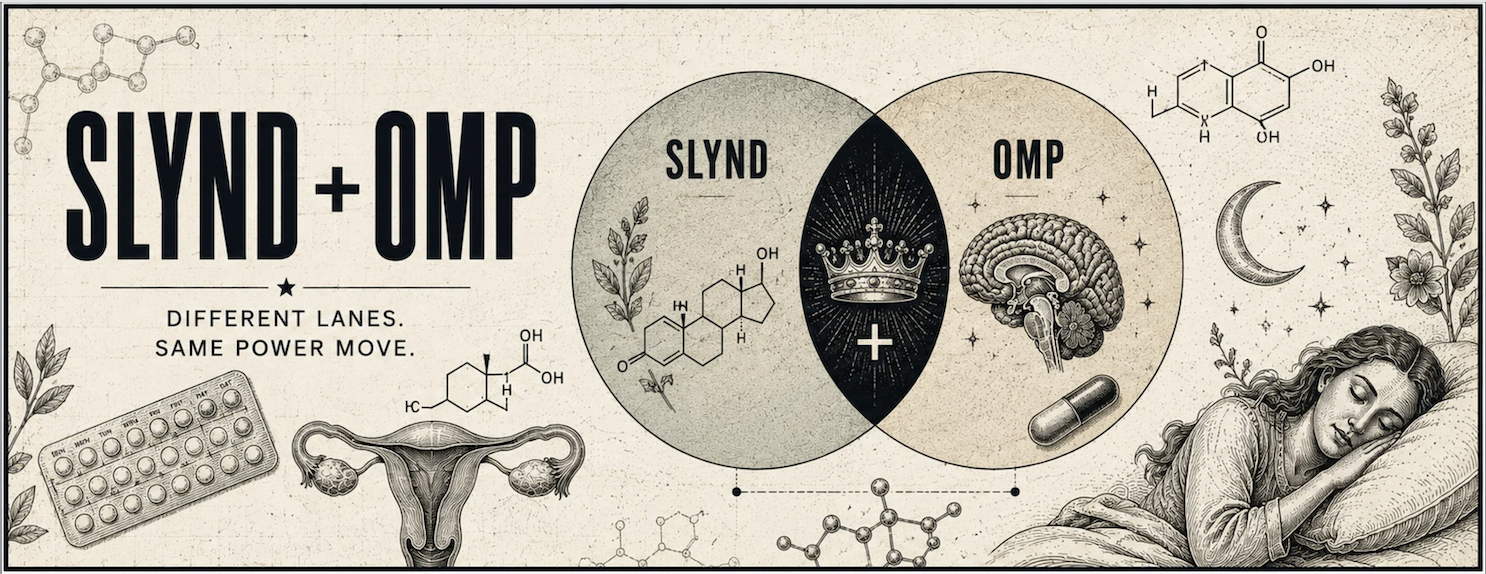
Slynd (drospirenone 4 mg) is a synthetic progestin. The multitasking overachiever. It consistently suppresses ovulation via anti-gonadotropic activity on LH (unlike our tired friend norethindrone, which mostly just gums up cervical mucus and hopes for the best), thins the endometrium, blocks the androgen receptor (goodbye acne, goodbye chin hairs), and blocks the mineralocorticoid receptor (goodbye bloat, goodbye "why am I crying about a commercial" fluid-driven mood swings). Bonus: a 24-hour missed-pill window (the most forgiving POP on the market). What Slynd does not do: cross the blood-brain barrier and behave like the progesterone your ovaries used to make back when they were still returning your calls.
Oral micronized progesterone (OMP) is bioidentical progesterone. The neurosteroid whisperer. Take it by mouth and hepatic first-pass metabolism converts it into allopregnanolone, a positive allosteric modulator at GABA-A. Yes, that receptor. The one benzos bind. Which is why 200–300 mg OMP at bedtime improves sleep architecture, quiets nocturnal awakenings, calms anxiety, and blunts vasomotor symptoms in a way no synthetic progestin, IUD, or Slynd tablet will ever pull off. Progestins are not progesterone. Repeat it. Cross-stitch it on a pillow. Tell your colleagues at rounds.


So the combo shines when your patient needs both:
- Bulletproof contraception + cycle control (Slynd's day job), and
- Sleep, sanity, and thermoregulation that only bioidentical progesterone delivers (OMP's night shift).
How I run it: Slynd 4 mg daily on the usual 24/4 for contraception, bleed control, and the anti-androgen/anti-mineralocorticoid glow-up. Add OMP 100–200 mg PO at bedtime for the neurosteroid magic. Always at bedtime, unless you want your patient to feel mildly drunk at a stoplight. Endometrial protection? Wildly over-engineered. Your patient's endometrium will be the thinnest, calmest tissue in the room.
The patient this was made for: the perimenopausal woman on Slynd for contraception and bleed control who is still not sleeping, still white-knuckling anxiety at 3 a.m., and still kicking the covers off at night. And who isn't ready for systemic estrogen yet. Add the OMP. Watch her come back at week four looking like she just returned from a spa in Ojai.
The nuance: If she's already on transdermal estradiol, OMP 100–200 mg qhs on its own usually covers both endometrial protection and the neurosteroid perks, and Slynd becomes optional. Keep it only if she needs the contraception, the androgen-blocking, or the fluid-shifting. Don't stack for sport. Stack when each molecule earns its seat at the table.

You know that feeling when a patient asks about HRT and you realize the last time you seriously studied hormone prescribing, iPods were still a thing and the guidelines have moved three times since? Yeah. Us too. So we built the antidote.

HRT Rx: Prescribing Hormone Therapy in the Modern Menopause Landscape
Built by Dr. Paul Maximus, Dr. Emma Lee, Dr. Madison Isenor, and Dr. Bobby Parmar, ND. For NDs, MDs, NPs, and any clinician who is deeply tired of being the one in the room who has to know this cold.
What's inside:
- Estrogens: estradiol, estrone, vaginal (Estragyn, Vagifem, compounded), dosing without vibes, GSM protocols that actually work
- Progesterone vs. progestins: oral vs. vaginal, why we've collectively benched Provera, and how to think about endometrial protection without living in fear
- Testosterone in perimenopause and menopause: the evidence, the doses, the off-label realities in Canada, and how to talk to your patient about it without whispering
- Non-hormonal VMS: fezolinetant, SSRIs, gabapentinoids, for the patients who can't or won't take HRT, without shrugging
- Contraindications, breast cancer history, VTE risk: stratified properly, not defensively
Why it matters: Because "just refer to gyne" is not a plan when the wait list is 14 months and your patient hasn't slept since March. Because your peri patients deserve a clinician who has read the actual WHI reanalysis, not the 2002 headline that has been aging in a barrel of fear ever since.
Enrollment opens August 1. Watch your inbox like it's a Beyoncé drop.

Want to go deeper on a clinical topic, talk through a complex case, or see how we run things at Gravity Health?


Come sit at the table. We saved you a seat.
See you next month,
Dr. Bobby Parmar & the Gravity Health team